Comparing line calling at the French Open to college tennis


Daniel Susann, Editor
Is it in or is it out? During play at Roland-Garros on the unique clay surface, it was sometimes hard to truly get a definitive answer.
Sticking with the traditional method for line calling, Roland-Garros opted to not use Hawk-Eye like almost every other professional tournament, instead maintaining use of line judges and ball marks, due to the painted lines becoming fuzzy on clay and the ball taking different trajectories with brick dust caked on.
Over the course of the tournament, a few calls could've gone in either direction, including a set point in the quarterfinal between former Virginia commit Joao Fonseca and Casper Ruud. The ball was called in, while Hawk-Eye saw it out by mere millimeters. It cost Ruud the second set and a chance to go up two sets to love, and Fonseca went on to win. Compared to other pro tournaments, the lack of standardization can be problematic. And in relation to what is now used for major events in college tennis, the French Open uses an arguably worse system.
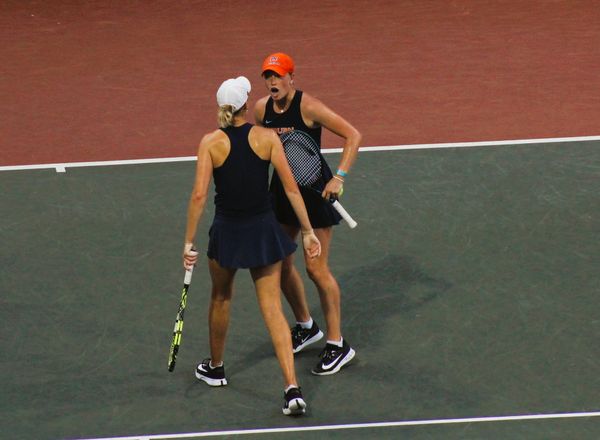
The ITA's new line calling system implemented in 2025 utilizes electronic line calling (ELC) in tandem with the standard player-based calling and chair umpires oversight. Without the resources for line judges at every angle, college tennis must rely on the players to make honest calls. With ELC, the players are kept in check.
Players can make up to three unsuccessful challenges per set, with an overrule resulting in a point penalty for players who erroneously call a ball out.
The college system allows players to take a risk by calling close balls, while the system at the French Open takes decisions out of the players' hands.
Whether or not Roland-Garros decides to adopt Hawk-Eye in the coming years is to be determined. But one thing has become clear: ELC is right for the college game.